
Serverless Architecture in 2026: Beyond Functions - Cold Starts, AI Inference & Global Edge
Complete guide to serverless architecture in 2026. Understand the true pay-per-use economics, compare cold start solutions (SnapStart, V8 Isolates, Bun), design event-driven serverless workflows with AWS Step Functions and Temporal, build AI inference pipelines with serverless GPU APIs, architect globally distributed edge functions, handle state management without servers, choose between Lambda, Cloudflare Workers, and Deno Deploy, and identify when traditional always-on compute wins.
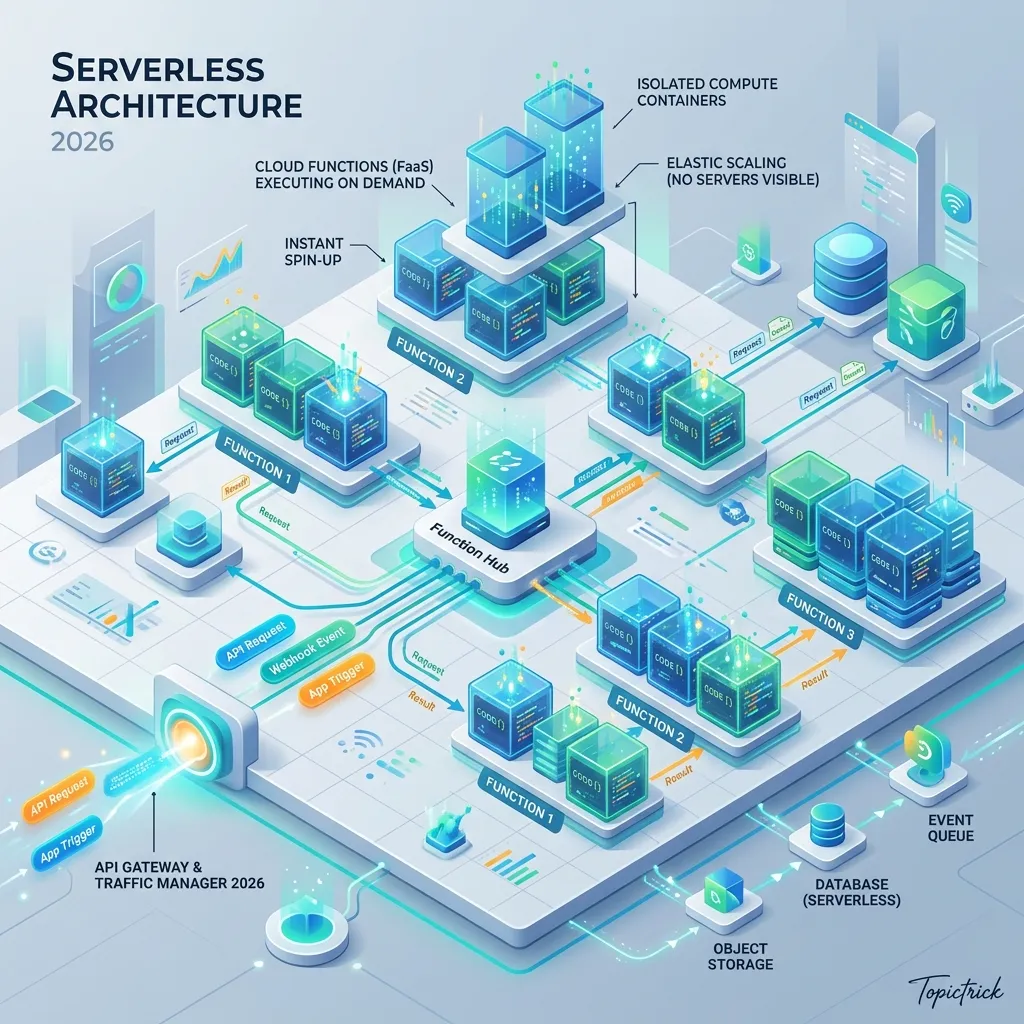
Serverless Architecture in 2026: Beyond Functions - Cold Starts, AI Inference & Global Edge
Table of Contents
- The Pay-for-Value Economics
- The Serverless Spectrum: FaaS to Containers
- How Event-Driven Triggers Work
- Cold Starts: The Problem and 2026 Solutions
- Serverless AI: The Biggest Growth Driver
- Edge Serverless: Cloudflare Workers vs Lambda@Edge
- State Management in a Stateless World
- Orchestrating Complex Workflows: Step Functions & Temporal
- Cost Model: When Serverless Wins vs Loses
- Vendor Lock-in: The Real Risk
- Frequently Asked Questions
- Key Takeaway
The Pay-for-Value Economics
Traditional cloud computing requires reserving capacity upfront:
Traditional VM/Kubernetes:
+-- 10 app instances x $0.10/hr = $0.10/hr minimum (even at 0 traffic)
+-- Pay for RAM/CPU you reserve, not use
+--- Over-provision for peak -> 70% utilization average

Serverless FaaS (Lambda):
+-- Pay per 1ms of actual execution
+-- Pay per actual requests (first 1M free on AWS)
+-- $0.00 at 3am when no traffic
+--- Infinite burst capacity - no capacity planning needed
Monthly cost example - API serving 100K requests/day:
- EC2 t3.medium (always on): ~$30/month
- AWS Lambda (100ms avg, 128MB): ~$2.50/month
- 12x cheaper at this traffic level
The crossover point: typically ~1-2M requests/month at 100-200ms average execution, or sustained 10-20% CPU utilization - beyond that, reserved compute is cheaper.
The Serverless Spectrum: FaaS to Containers
Function-as-a-Service (FaaS): AWS Lambda, Google Cloud Functions, Cloudflare Workers. Stateless, request-scoped, millisecond billing, hard limits (15min max in Lambda, 30s in Workers).
Serverless Containers: AWS Fargate, Google Cloud Run, Azure Container Apps. Your container runs on demand, scales to zero, but you control the runtime. No 15-minute limit. Better for long-running processes (video processing, ML inference batches).
How Event-Driven Triggers Work
Serverless functions are dormant until an event wakes them:
# Lambda handler - the complete "server" for this endpoint:
import json

def handler(event, context):
    # event contains HTTP request details (API Gateway proxy format)
    http_method = event['httpMethod']
    path = event['path']
    body = json.loads(event.get('body') or '{}')

    if http_method == 'POST' and path == '/orders':
        # Business logic here
        order = create_order(body)
        return {
            'statusCode': 201,
            'headers': {'Content-Type': 'application/json'},
            'body': json.dumps({'orderId': order.id})
        }

    return {'statusCode': 404, 'body': 'Not Found'}
Cold Starts: The Problem and 2026 Solutions
A cold start occurs when a new instance of your function is initialised from scratch - the cloud provider must:
- Allocate a container
- Load your code and dependencies
- Execute your initialisation code
- Then handle the request
Typical cold start latencies (2024 benchmarks):
| Runtime | P50 Cold Start | P99 Cold Start |
|---|---|---|
| Node.js 20 | 200ms | 800ms |
| Python 3.12 | 250ms | 900ms |
| Java 21 (without SnapStart) | 1,500ms | 4,000ms |
| Java 21 + AWS SnapStart | 90ms | 300ms |
| Go 1.22 | 80ms | 250ms |
| Cloudflare Workers (V8 Isolate) | < 5ms | < 15ms |
| Bun on Lambda | 60ms | 200ms |
2026 Solutions:
-
AWS Lambda SnapStart (Java): Takes a snapshot of the initialized JVM. Subsequent cold starts restore from snapshot instead of JVM boot - 10x improvement.
-
Cloudflare Workers (V8 Isolates): Not a container per request - each request runs in a V8 JavaScript isolate (same tech as Chrome tabs). Startup time: microseconds.
-
Provisioned Concurrency (AWS): Pre-warm N instances so they're always ready - eliminates cold starts at a cost (you pay for idle warm instances).
-
Choose Go/Bun/Rust: Compiled languages with minimal runtime startup are naturally cold-start-friendly.
Serverless AI: The Biggest Growth Driver
Serverless AI is the primary force expanding the serverless market in 2026:
# Serverless LLM inference - no GPU management required:
import anthropic

client = anthropic.Anthropic()

# This calls Anthropic's serverless compute - you pay per input/output token
# No GPU provisioning, no model loading, no scaling
message = client.messages.create(
    model="claude-opus-4-5",
    max_tokens=1024,
    messages=[{"role": "user", "content": "Summarise this contract..."}]
)

# Same pattern for image generation, embedding models, speech-to-text
# The entire ML inference stack is abstracted away
Serverless AI platforms in 2026:
| Platform | Models | Pricing Model |
|---|---|---|
| AWS Bedrock | Claude, Llama, Mistral, Titan | Per token |
| Google Vertex AI | Gemini, Claude, open-source | Per token + per second |
| Together AI | 50+ open-source models | Per token |
| Replicate | Image, video, audio models | Per second of compute |
| Modal | Custom models (bring your own) | Per second of GPU |
State Management in a Stateless World
Serverless functions are ephemeral - they have no memory between requests. State must be externalised:
| State Type | Solution | Latency |
|---|---|---|
| Session state | Redis (Upstash, ElastiCache) | < 1ms |
| User data | DynamoDB, PlanetScale, Turso | 1-10ms |
| File storage | S3, R2, Cloudflare KV | 5-50ms |
| Long-lived workflow state | Temporal, AWS Step Functions | Durable |
| Short-lived computation cache | Lambda /tmp (up to 10GB) | < 1ms |
| Global edge KV | Cloudflare KV, Deno KV | < 5ms |
# Serverless function with DynamoDB for state:
import boto3
dynamodb = boto3.resource('dynamodb')
table = dynamodb.Table('user-sessions')

def handler(event, context):
    user_id = event['requestContext']['authorizer']['userId']

    # Read state from DynamoDB (external, durable)
    session = table.get_item(Key={'userId': user_id}).get('Item')

    # Process request using session state
    result = process_with_session(event, session)

    # Write updated state back
    table.put_item(Item={'userId': user_id, **result.updated_state})

    return {'statusCode': 200, 'body': json.dumps(result.response)}
Cost Model: When Serverless Wins vs Loses
Serverless WINS when:
✅ Traffic is spiky, unpredictable, or low-volume
✅ You have many small isolated functions
✅ Zero-traffic periods exist (nights, weekends)
✅ You need infinite burst capacity (flash sales, viral moments)
✅ Development speed > operational cost

Serverless LOSES when:
❌ Sustained high CPU utilization (> 50% continuously)
❌ Functions exceed 15-minute execution limit
❌ Large in-memory datasets needed across requests
❌ Sub-10ms cold start requirements for all users
❌ Regulatory requirements for dedicated infrastructure
Frequently Asked Questions
Is Kubernetes dead? Should everything be serverless? No - Kubernetes and serverless serve different use cases. Kubernetes excels at long-running, stateful workloads with complex networking requirements (databases, ML training, WebSocket servers, background workers). Serverless excels at stateless, request-scoped processing with variable traffic. Most large systems use both: Kubernetes for persistent services, serverless for event-driven processing and APIs.
How do I avoid vendor lock-in with serverless? Use the Serverless Framework or AWS CDK with portable abstractions. Implement your business logic as pure functions that receive/return standard request/response objects - avoid using vendor-specific SDKs directly inside your business logic. Use OpenTelemetry for observability (not vendor-proprietary agents). The adapter pattern from Hexagonal Architecture applies here: your core code knows nothing about Lambda; a thin adapter translates Lambda events to your domain objects.
Key Takeaway
Serverless in 2026 is the dominant architecture for new API services, event-driven processing, and AI inference pipelines - not because it's always cheaper, but because it eliminates the operational tax of managing servers. Cold starts are largely solved for most runtimes. The remaining limits (15-minute execution, statelessness, vendor lock-in) are engineering constraints to design around, not fundamental blockers. For the majority of web APIs, background jobs, and AI-powered features in 2026, the answer to "Should I use serverless?" is: "Yes, unless you have specific requirements that make traditional compute objectively better."
Read next: Platform Engineering Architecture: The Internal Developer Platform ->
Part of the Software Architecture Hub - comprehensive guides from architectural foundations to advanced distributed systems patterns.