
DB2 Tutorial: The Complete Guide to Learning IBM DB2 (2026)
The definitive DB2 tutorial for 2026. Learn IBM DB2 from SQL fundamentals to z/OS mainframe programming, performance tuning, and DBA administration — 27 free modules, beginner to senior.
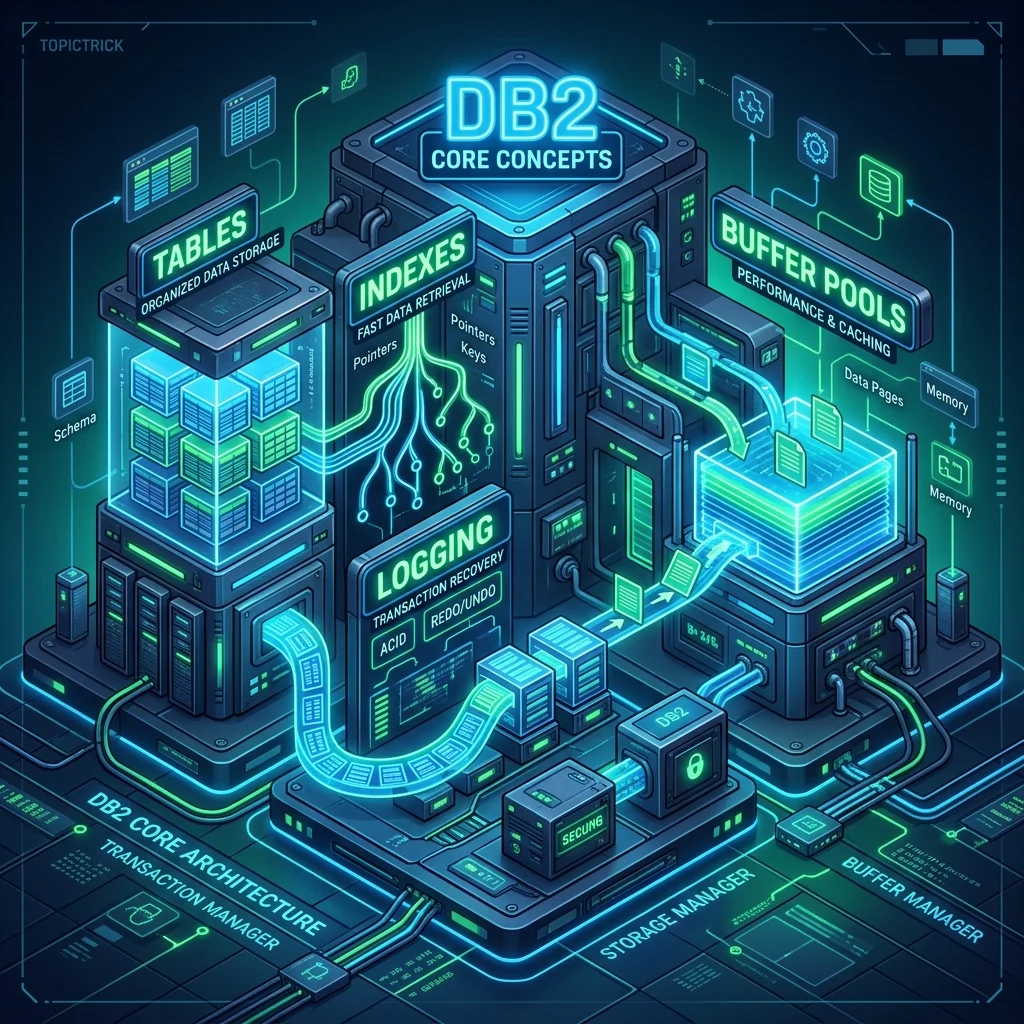
DB2 Tutorial: The Complete Guide to Learning IBM DB2 (2026)
IBM DB2 is the relational database that quietly runs the world's most critical systems. While it rarely appears in developer surveys, DB2 processes a significant proportion of global banking transactions, insurance policy records, and government data every single day. For developers and DBAs working in enterprise environments, financial services, insurance, or any organisation running IBM mainframe infrastructure, DB2 knowledge is not optional — it is a career-defining skill.
This tutorial is the complete reference for learning IBM DB2 in 2026. It covers everything from your first SQL query to z/OS mainframe programming, performance tuning with EXPLAIN, and full DBA administration — organised into 27 modules across 7 phases. Every module is free, practical, and built for real enterprise environments.
What Is IBM DB2?
IBM DB2 (officially called "Db2" since version 11.1) is a family of relational database management systems developed by IBM. It is based on the relational model and uses SQL as its primary query language, with proprietary extensions for advanced features.
DB2 exists in two main editions that you need to understand:
DB2 LUW (Linux, UNIX, Windows) — the distributed version that runs on commodity server hardware. This is the edition most developers encounter first and is available as a free community edition for development use.
DB2 for z/OS — the mainframe edition that runs exclusively on IBM Z hardware under the z/OS operating system. This is the edition that processes the world's banking transactions, airline reservations, and government records. It is architecturally different from DB2 LUW in several important ways — different administrative commands, different storage model, tighter integration with JCL, COBOL, and CICS.
This tutorial covers both editions. The Foundation and SQL phases apply equally to both. The DB2 for z/OS phase covers the mainframe-specific topics.
Why Learn DB2 in 2026?
Three facts define the DB2 market in 2026:
Critical infrastructure dependency. The majority of the world's top banks, insurance companies, and government agencies run their core systems on IBM mainframes with DB2. These systems cannot be easily replaced — the risk and cost of migration are too high. DB2 will be running in production in 2036 and beyond.
Talent shortage. The average mainframe DB2 developer and DBA is over 40. A significant wave of retirements is underway. IBM and its enterprise clients are actively competing to hire DB2-skilled engineers, driving salaries above the typical market rate for database roles.
Salary premium. DB2 DBA roles in enterprise environments regularly command salaries of $120,000–$160,000+ in the United States. COBOL/DB2 developer roles in financial services pay a similar premium. The specialist nature of the skill, combined with the criticality of the systems, sustains this premium indefinitely.
How This Tutorial Is Organised
The 27 modules are divided into 7 phases. Work through them in order if you are new to DB2. If you have existing SQL knowledge, skip ahead to Phase 3 or the DB2 for z/OS phase.
Phase 1: Foundations
The Foundation phase covers what DB2 is, how it is structured internally, what data types it supports, and how to set up a local development environment. These modules provide the conceptual base for everything that follows.
Module 1 — IBM DB2 Introduction: The Complete Beginner's Guide (2026) What DB2 is, who uses it, the difference between DB2 LUW and DB2 for z/OS, and why it remains essential in enterprise data engineering in 2026.
Module 2 — DB2 Architecture Explained: Instances, Databases & Buffer Pools A deep dive into the internal structure of a DB2 system — how data flows from disk through buffer pools into memory, how instances relate to databases, and how storage is organised.
Module 3 — DB2 Data Types: The Complete Reference Guide with Examples CHAR, VARCHAR, DECIMAL, DATE, TIMESTAMP, CLOB and every other DB2 data type — when to use each, storage implications, and common mistakes to avoid in production schemas.
Module 4 — DB2 Installation and Setup: Windows, Linux & z/OS Guide Step-by-step installation of DB2 LUW on Windows and Linux, plus an overview of the z/OS environment setup and how to access IBM's free Z Xplore mainframe learning environment.
Phase 2: SQL Essentials
The SQL Essentials phase covers the core SQL operations you will use in every DB2 project: querying data, modifying data, joining tables, and aggregating results.
Module 5 — DB2 SELECT Statement: Complete Guide with Real Examples Master the SELECT statement — FROM, WHERE, ORDER BY, DISTINCT, FETCH FIRST, column aliases, and expressions used in production DB2 queries.
Module 6 — DB2 INSERT, UPDATE, DELETE: DML Operations Complete Guide Writing reliable DML in DB2 — multi-row inserts, conditional updates, cascaded deletes, and transaction safety patterns for enterprise systems.
Module 7 — DB2 JOINs Explained: INNER, LEFT, RIGHT, FULL OUTER with Examples Every JOIN type in DB2 — syntax, real-world use cases, performance implications, and the common mistakes that cause incorrect results or full table scans.
Module 8 — DB2 Aggregate Functions: COUNT, SUM, AVG, MAX, MIN with Examples Group and summarise data with DB2 aggregate functions, including the advanced grouping operations GROUPING SETS, ROLLUP, and CUBE.
Module 9 — DB2 WHERE, GROUP BY, and HAVING: Filtering and Grouping Data How to filter rows with WHERE, group results with GROUP BY, and apply post-aggregation filters with HAVING — with examples from financial reporting queries.
Module 10 — DB2 NULL Handling: IS NULL, COALESCE, NULLIF and NVL NULL behaviour in DB2 SQL — three-valued logic, NULL in aggregation, COALESCE patterns, and how to handle NULLs safely in production queries without subtle bugs.
Phase 3: Advanced SQL
The Advanced SQL phase covers the techniques that separate intermediate DB2 developers from seniors: CTEs, window functions, stored procedures, triggers, views, and conditional logic.
Module 11 — DB2 Subqueries and CTEs: Writing Complex Queries Correlated subqueries, scalar subqueries, EXISTS, IN, and Common Table Expressions (the WITH clause) in DB2 — with real examples from analytics and reporting.
Module 12 — DB2 Window Functions: ROW_NUMBER, RANK, LAG, LEAD Explained Analytical queries with DB2 window functions — partitioning, ordering, frame specification, and real-world use cases in financial reporting and time-series analysis.
Module 13 — DB2 Stored Procedures: Complete Guide with Examples Writing, calling, and maintaining DB2 stored procedures in SQL PL — input/output parameters, cursors, error handling, and the performance benefits of server-side logic.
Module 14 — DB2 Triggers: CREATE, ALTER, DROP with Real-World Examples BEFORE, AFTER, and INSTEAD OF triggers in DB2 — audit logging patterns, referential integrity enforcement, and trigger performance considerations.
Module 15 — DB2 Views and Materialized Query Tables: Complete Guide Creating and querying DB2 views and MQTs — read-only views, updatable views, materialized caching, and automatic query rewrite for reporting performance.
Module 16 — DB2 CASE Expressions and Conditional Logic: Complete Guide CASE WHEN, DECODE, NULLIF, and COALESCE in DB2 — writing conditional transformations inside SQL queries for classification, bucketing, and data cleansing.
Phase 4: DB2 for z/OS
The DB2 for z/OS phase is unique to this tutorial. It covers the mainframe-specific architecture, tooling, and programming patterns that define enterprise DB2 work.
Module 17 — DB2 for z/OS: Introduction to Mainframe Database (2026) How DB2 on z/OS differs from DB2 LUW — Parallel Sysplex, coupling facility shared caching, subsystem structure, thread management, and the z/OS storage hierarchy.
Module 18 — DB2 JCL Utilities: RUNSTATS, REORG, COPY, LOAD, UNLOAD Guide Running DB2 batch utilities from JCL — syntax, options, output interpretation, and scheduling best practices for production maintenance windows.
Module 19 — COBOL and DB2: Embedded SQL Programming Complete Guide Writing embedded SQL in COBOL programs — cursors, SQLCODE handling, host variables, DCLGEN, and the precompile/compile/bind cycle used in every mainframe shop.
Module 20 — CICS and DB2: Online Transaction Programming Guide DB2 thread management in CICS transactions — pseudo-conversational design, SQL in CICS programs, and commit/rollback strategy for high-volume online systems.
Phase 5: Performance & Optimisation
The Performance phase covers the techniques DBAs and senior developers use to diagnose and fix slow queries, design effective indexes, and manage concurrency in high-throughput environments.
Module 21 — DB2 EXPLAIN and Query Optimisation: Performance Tuning Guide Reading the PLAN_TABLE, understanding access paths (table scan vs index scan), and using Visual Explain to identify and fix slow queries in DB2.
Module 22 — DB2 Indexes: Types, Creation, and Performance Impact Clustering indexes, composite indexes, index-only access, and how the DB2 optimizer chooses access paths — with practical guidance on index design for production tables.
Module 23 — DB2 Locking, Concurrency and Isolation Levels Explained DB2 lock types, deadlock detection and resolution, isolation levels (UR, CS, RS, RR), and designing applications to minimise locking contention in high-volume environments.
Module 24 — DB2 RUNSTATS and REORG: Keeping Your Database Healthy When and how to run RUNSTATS and REORG — statistics staleness, tablespace fragmentation, and automating maintenance to prevent performance degradation.
Phase 6: Administration
The Administration phase covers the operational skills required to maintain a DB2 system in production: backup and recovery, security, and privilege management.
Module 25 — DB2 Backup and Recovery: Complete DBA Guide Full, incremental, and delta backups in DB2 — online vs offline backup, restore and rollforward procedures, and disaster recovery strategy for production systems.
Module 26 — DB2 Security: GRANT, REVOKE, Roles and Row-Level Security DB2 privilege model — database authorities, object privileges, roles, Trusted Context, and Label-Based Access Control (LBAC) for row-level security in regulated environments.
Phase 7: Career
Module 27 — DB2 Interview Questions and Answers (2026): 50 Questions The 50 most common DB2 interview questions covering SQL, z/OS architecture, performance, locking, COBOL integration, and administration — with full answers.
What You Can Do After Completing This Tutorial
Working through all 27 modules prepares you to:
- Write production DB2 SQL — SELECT, JOINs, CTEs, window functions, stored procedures, and conditional logic used in real enterprise systems.
- Work with embedded SQL in COBOL — cursors, host variables, SQLCODE handling, and the precompile/bind workflow at the heart of mainframe application development.
- Tune slow queries — read EXPLAIN output, understand optimizer access paths, design effective indexes, and eliminate locking contention.
- Administer a DB2 system — backup and recovery, RUNSTATS, REORG, privilege management, and LBAC row-level security.
- Operate confidently on DB2 for z/OS — understand the mainframe architecture differences, JCL utilities, and CICS transaction thread management.
Frequently Asked Questions
Is DB2 worth learning in 2026? Yes — the combination of critical infrastructure dependency, ageing talent pool, and salary premium makes DB2 one of the highest-ROI specialist skills available in enterprise technology.
Should I learn DB2 LUW or DB2 for z/OS? Start with DB2 LUW — it is freely available, installs on your laptop, and the SQL skills transfer directly to z/OS. Once you are comfortable with SQL and want to work in mainframe environments, the z/OS modules in Phase 4 of this tutorial cover the specific differences.
What is the DB2 DBA certification path? IBM offers the Db2 12 for z/OS Database Administrator exam (C2090-320) for mainframe DBAs and the Db2 11.5 Database Administrator exam for LUW DBAs. See the DB2 DBA Certification Guide for the full study path.
Ready to go deeper?
This tutorial gives you the knowledge. The DB2 Mastery Course structures it into a guided path with phase-by-phase progression, starting from Module 1 and building through all 27 chapters.