
CICS Tutorial: The Complete Guide to IBM CICS Programming (2026)
The definitive CICS tutorial for 2026. Learn IBM CICS from transaction fundamentals to BMS maps, COMMAREA, DB2 integration, and REST API modernisation — 22 free modules, beginner to senior.
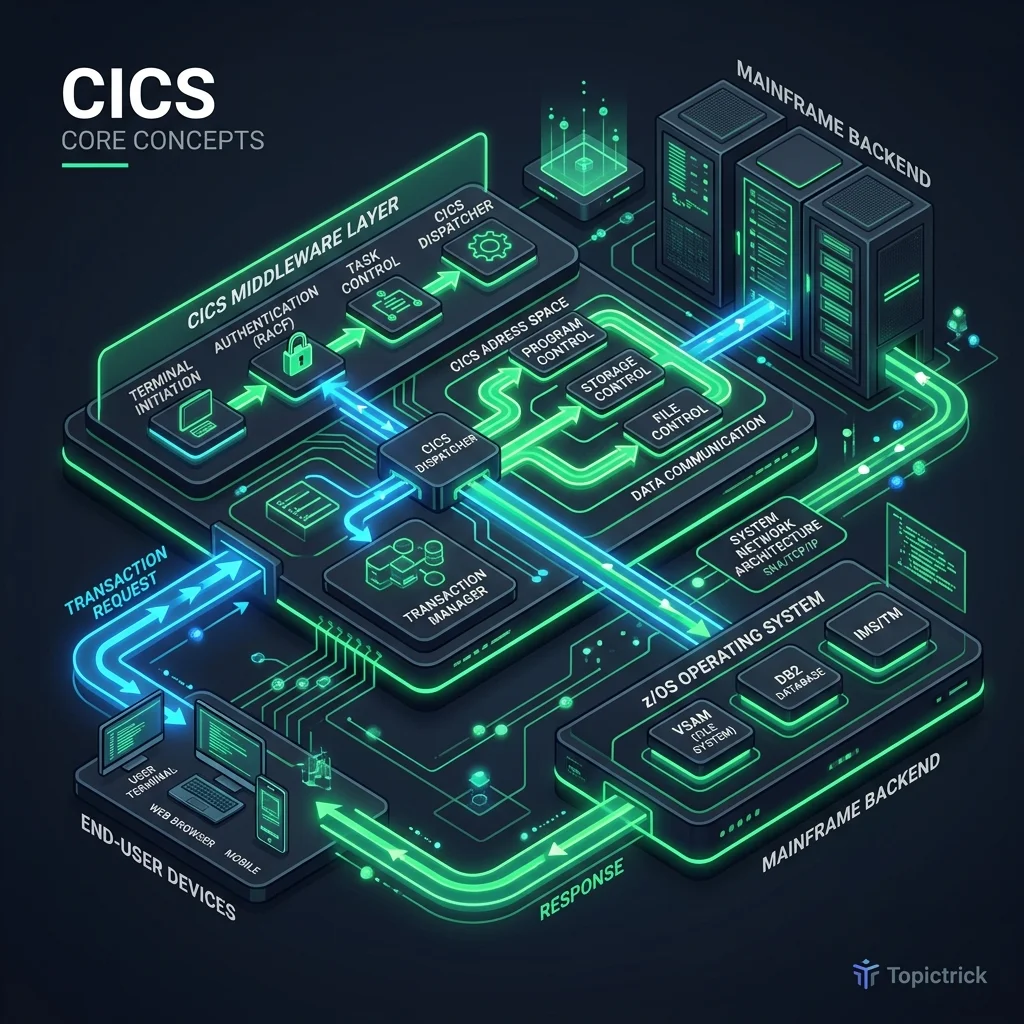
CICS Tutorial: The Complete Guide to IBM CICS Programming (2026)
IBM CICS is the transaction engine that powers the world's most critical online systems. Every ATM withdrawal, airline booking, insurance claim, and government benefit payment is likely processed — directly or indirectly — by CICS running on IBM mainframe infrastructure. For developers working in enterprise environments, financial services, or any organisation with mainframe presence, CICS programming is one of the most commercially valuable skills available.
This tutorial is the complete reference for learning IBM CICS in 2026. It covers CICS transaction fundamentals, COBOL application programming, BMS terminal maps, COMMAREA data exchange, DB2 integration, web services, and production administration — organised into 22 modules across 6 phases. Every module is free, practical, and built for real enterprise environments.
What Is CICS?
CICS (Customer Information Control System) is IBM's online transaction processing (OLTP) middleware for z/OS mainframes. It was introduced in 1968 and has been the dominant mainframe OLTP platform ever since.
In practical terms, CICS sits between the user (a terminal, a web service, or another program) and your COBOL application logic. When a user enters data into a screen or a REST client sends a request, CICS:
- Receives the input and identifies the transaction
- Allocates storage and invokes your COBOL program
- Manages the interaction with DB2, VSAM files, or queues
- Returns the output to the caller
- Handles commit/rollback to ensure data integrity
This architecture lets a single CICS region service thousands of concurrent transactions with the throughput and reliability that enterprise systems demand.
Why CICS in 2026?
Three facts define the CICS market today:
Unmatched throughput at scale. CICS processes an estimated 1.2 million transactions per second globally. No other platform approaches this throughput for OLTP workloads at banking and insurance scale.
Irreplaceable infrastructure. The cost and risk of migrating decades of CICS applications to alternative platforms is prohibitive for most large enterprises. CICS will be running production workloads well into the 2030s and beyond.
Structural talent shortage. The average CICS developer is approaching retirement age. IBM and its enterprise clients are competing to hire CICS-skilled engineers, creating persistent salary premiums for those who invest in the skill.
How This Tutorial Is Organised
The 22 modules are divided into 6 phases. Work through them in sequence if you are new to CICS. The CICS Foundations and CICS Programming phases are the critical path — all later modules assume that knowledge.
Phase 1: CICS Foundations
The Foundation phase covers what CICS is, how it processes transactions, its internal architecture, and the resource definitions that control its behaviour. These four modules provide the conceptual framework for everything that follows.
Module 1 — What is CICS? Introduction, History, and Use Cases (2026) What CICS is, where it came from, who uses it, and why CICS skills remain essential in 2026. The starting point for every CICS learner.
Module 2 — CICS Architecture: Regions, Address Spaces, and Components How CICS is structured internally — regions, address spaces, the CICS dispatcher, storage management, and how CICS integrates with z/OS. The mental model you need before writing code.
Module 3 — CICS Transaction Processing: How Transactions Work End to End What a CICS transaction is, the transaction lifecycle from input to output, task management, and how CICS ensures atomicity and recovery for online workloads.
Module 4 — CICS Resource Overview: Programs, Maps, Files, Queues and More The complete inventory of CICS resources — programs, transactions, BMS maps, files, temporary storage queues, transient data queues, and the CSD (CICS System Definition) that controls them.
Phase 2: CICS Programming
The Programming phase is the heart of this tutorial. These five modules cover everything you need to write production CICS COBOL programs — from the EXEC CICS interface and EIB to BMS terminal maps, COMMAREA data exchange, and pseudo-conversational design.
Module 5 — CICS COBOL Programming: Structure, Linkage Section, and Entry Points How to structure a COBOL program for CICS — the Linkage Section, DFHCOMMAREA, entry and exit points, and the differences between batch COBOL and CICS COBOL that catch developers out.
Module 6 — CICS Exec Interface Block (EIB): Reading Transaction Context The EIB is your window into the CICS environment from within a program. This module covers every important EIB field — EIBAID, EIBCALEN, EIBTRMID, EIBTIME — and how to use them in conditional program logic.
Module 7 — CICS BMS Maps: Designing and Using Terminal Screens Basic Mapping Support — how to define a BMS mapset and map, assemble it, SEND MAP to display a screen, RECEIVE MAP to capture input, and handle field attributes for validation and highlighting.
Module 8 — CICS COMMAREA: Passing Data Between Programs and Transactions COMMAREA is the primary mechanism for passing data between CICS programs and between pseudo-conversational tasks. This module covers LINK, XCTL, RETURN with COMMAREA, length handling, and common COMMAREA design patterns.
Module 9 — CICS Pseudo-Conversational Programming: Design and Implementation The pseudo-conversational design pattern is fundamental to CICS. This module explains why it exists, how to implement it with RETURN/COMMAREA, how to manage conversation state, and the pitfalls to avoid in multi-step transaction flows.
Phase 3: CICS Commands
This phase covers the full range of EXEC CICS commands used in production programming — file I/O, program control, terminal I/O, error handling, and storage management.
Module 10 — CICS File Control: READ, WRITE, REWRITE, DELETE for VSAM Files EXEC CICS READ, WRITE, REWRITE, DELETE, and STARTBR/READNEXT for sequential browsing. File control is the primary mechanism for accessing VSAM datasets from CICS programs.
Module 11 — CICS Program Control: LINK, XCTL, CALL, and LOAD How to invoke other programs from CICS — LINK (subprogram call with return), XCTL (transfer control without return), CALL, and LOAD for dynamic loading. When to use each and the storage implications.
Module 12 — CICS SEND and RECEIVE: Terminal I/O Beyond BMS Maps EXEC CICS SEND TEXT, SEND CONTROL, RECEIVE, and how to handle terminal communication outside the standard BMS map flow. Includes erase/write patterns and cursor positioning.
Module 13 — CICS Error Handling: HANDLE CONDITION, RESP, and ABEND Handling errors in CICS programs — HANDLE CONDITION, the RESP and RESP2 approach, ABEND codes, ASSIGN, and how to implement robust error handling that produces meaningful diagnostic output.
Module 14 — CICS Storage Control: GETMAIN, FREEMAIN, and Storage Management Dynamic storage allocation in CICS — EXEC CICS GETMAIN and FREEMAIN, above-the-line storage, storage violations, and how to avoid the storage-related ABENDs that are common in production CICS programs.
Phase 4: Queues and Communication
This phase covers CICS inter-program communication mechanisms — temporary storage queues, transient data queues, and interval control for deferred processing.
Module 15 — CICS Temporary Storage Queues: WRITEQ TS, READQ TS, DELETEQ TS Temporary Storage (TS) queues provide a scratchpad for passing data between tasks or storing intermediate state. This module covers WRITEQ TS, READQ TS, DELETEQ TS, shared queues in Sysplex environments, and TS queue design patterns.
Module 16 — CICS Transient Data Queues: WRITEQ TD and Intrapartition vs Extrapartition Transient Data (TD) queues provide fire-and-forget messaging. This module covers intrapartition queues (triggering programs when thresholds are reached) and extrapartition queues (writing to datasets outside CICS).
Module 17 — CICS Interval Control: START, CANCEL, and Deferred Processing EXEC CICS START to schedule a transaction to run at a future time, CANCEL to remove it, and the patterns used for deferred processing, timeout handling, and asynchronous workflows in CICS.
Phase 5: CICS and DB2
The DB2 integration phase covers the two most critical integration patterns in enterprise CICS development — embedded SQL for database access and web services for modern API connectivity.
Module 18 — CICS and DB2 Integration: SQL in CICS Programs How DB2 SQL works inside CICS programs — thread management, commit/rollback in the CICS transaction context, cursor handling, SQLCODE checking, and the performance considerations specific to CICS/DB2 integration.
Module 19 — CICS Web Services: REST APIs, JSON Processing, and Modernisation How to expose CICS business logic as REST and SOAP web services using URIMAP and PIPELINE resources. Covers JSON processing in COBOL, service provider and requester patterns, and the CICS-as-API-gateway architecture used in mainframe modernisation.
Phase 6: Administration and Career
Module 20 — CICS Resource Definitions: CSD, RDO, and CEDA Commands How CICS resources are defined in the CSD using RDO (Resource Definition Online) — CEDA DEFINE, INSTALL, DISPLAY, and the complete set of resource types. How to manage the CSD for production and test environments.
Module 21 — CICS Monitoring and Performance: Statistics, Trace, and Tuning CICS performance monitoring — CICS statistics, transaction monitoring, CICS trace, CICS PA (Performance Analyser), and the tuning levers available for throughput and response time optimisation.
Module 22 — CICS Interview Questions and Answers (2026): 50 Questions The 50 most common CICS interview questions covering architecture, programming, BMS, COMMAREA, DB2 integration, error handling, and administration — with full answers.
What You Can Do After Completing This Tutorial
Working through all 22 modules prepares you to:
- Write production CICS COBOL programs — EIB interrogation, EXEC CICS commands, error handling, and storage management used in real enterprise systems.
- Build BMS terminal interfaces — Design mapsets, SEND and RECEIVE maps, handle field attributes, and implement multi-screen pseudo-conversational flows.
- Integrate CICS with DB2 — Manage threads, write embedded SQL inside CICS programs, handle commits and rollbacks correctly in the transaction context.
- Expose CICS as a REST API — Use URIMAP and PIPELINE to wrap existing CICS business logic as web services for modern application integration.
- Administer a CICS region — Define and install resources via the CSD, monitor performance statistics, and diagnose ABENDs and storage violations.
Ready to go deeper?
The CICS Mastery Course structures all 22 modules into a guided path with phase-by-phase progression — from your first CICS transaction to production DB2 and web services integration.